
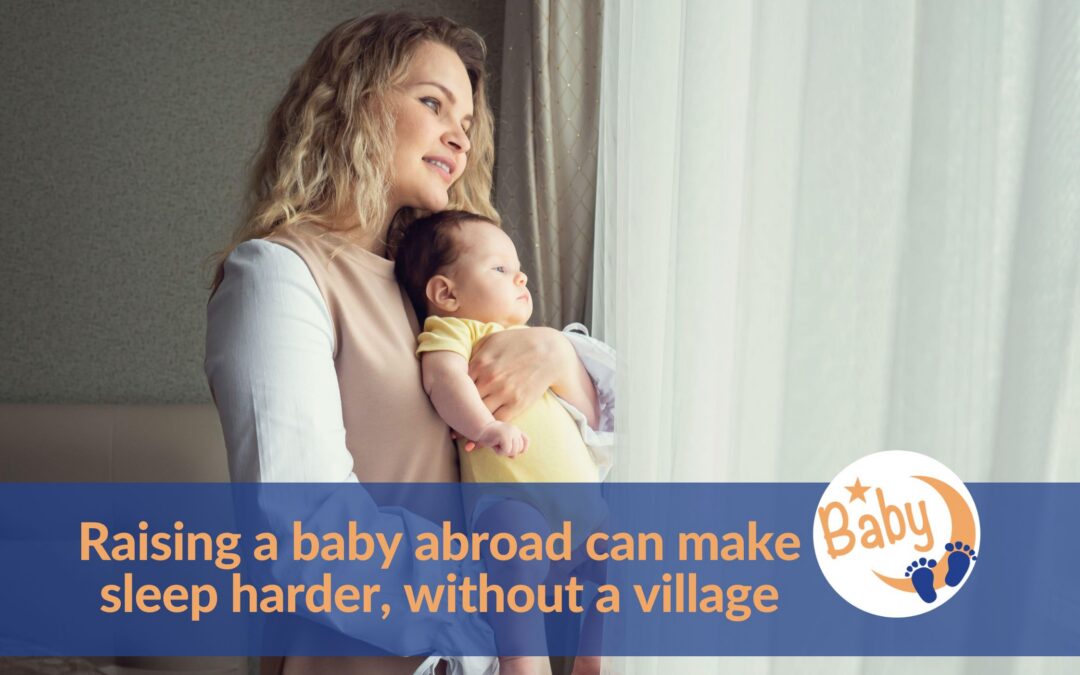
Raising a baby abroad without family support can make an ordinary sleep challenge feel much bigger. When there is no grandparent nearby to hold the baby, prepare lunch or take an early-morning shift, every difficult nap and night waking lands on the same one or two adults. Baby sleep then affects recovery, mood, work, relationships and the atmosphere at home.
Perhaps you chose life abroad because of work, love, adventure or a mixture of all three. Then your baby arrived and the distance changed shape. Home was no longer only a flight away. It was also the place where someone might have noticed you were exhausted and quietly made dinner.
Video calls can provide emotional connection, but relatives who live far away cannot help with daily tasks at home.
Why baby sleep can feel harder when you live abroad
Living abroad does not automatically cause a baby to sleep poorly. Babies wake for many reasons, including hunger, development, discomfort, illness, changing sleep needs and the way they are accustomed to falling asleep.
What changes without a nearby village is the family’s capacity to recover from those wakings and respond consistently.
After a difficult night, the same parent may still be responsible for the morning, meals, appointments and perhaps paid work. Repeated broken nights can affect patience, concentration and decision-making. Even a question such as “Should the second nap happen now?” can begin to feel like a matter of international diplomacy.
Expat parents may also receive advice from several cultures at once. Family members back home might have firm opinions about feeding, room-sharing, bedtimes or how much help a baby should receive to fall asleep. Local (ex. German) healthcare guidance may feel unfamiliar, while online advice adds another noisy layer.
Sleep culture differs. The useful question is: what is safe, age-appropriate and workable for your family?
Why sleep becomes a whole-family issue
Sleep moves through a family in both directions. A baby’s frequent waking interrupts the adults’ sleep. Exhausted adults may then find routines, calm responses and teamwork harder to maintain.
This does not mean parental stress caused the baby’s sleep difficulty. But sleep, mental health and family functioning can influence one another.
A 2025 longitudinal study found bidirectional associations between maternal and infant sleep and maternal mental health from late pregnancy to two years after birth. The exact pattern varied over time, but the practical message is valuable: caring for the parent and understanding the baby’s sleep belong in the same conversation.
Exhaustion reduces emotional bandwidth
At 2 am, waiting 3 minutes to observe what your baby needs may feel too long. Parents may switch rapidly between feeding, rocking, carrying and other forms of support because everyone needs sleep immediately.
When you are extremely tired, it is understandable to try several ways to help your baby fall asleep as quickly as possible. But changing your response repeatedly can confuse your baby. So, it is better to choose 1-2 simple approaches that you can realistically follow, even during a difficult night.
A realistic sleep plan must work on a difficult night, not only when both parents feel rested and calm.
The couple becomes a two-person night-shift
Without outside support, partners can begin measuring exhaustion against each other. Who got up more? Whose workday matters tomorrow? Who is responsible for bedtime?
Fairness does not always mean splitting every waking equally. It means making the invisible work visible and agreeing who will do what.
In such a case, taking turns or shifts can help. One parent can manage the first part of the night while the other takes the early morning. If one parent is breastfeeding, the partner can still handle resettling, breakfast or the older child’s morning.
Resentment may also grow if the “job description” is not clear. A written plan or a routine stuck on the fridge door may be less romantic than flowers, but at 4 am it can be more useful.
Parental care belongs in the sleep puzzle
If we look at your baby sleep as a puzzle, we notice that, most of the time, the missing piece is not the obvious one. For example, if bedtime is difficult, the answer could lie in the daytime routine, naps, light, movement, feeding, connection, the sleep environment or how your baby usually falls asleep.
For families living abroad, I would add another piece: parental capacity.
In my work with international families, I see that even an excellent sleep plan will fail if it requires two calm, rested adults every evening while one exhausted parent is doing bedtime or night time alone. The plan must fit the people who will carry it out.
So, start with these 4 questions:
- Is your baby’s sleep routine age-appropriate? Newborn sleep is naturally very fragmented. Older babies and toddlers still wake, although the reasons and helpful responses change with age.
- Could health, feeding or discomfort be involved? Poor weight gain, feeding difficulties, pain, unusual breathing, loud snoring or a sudden sleep change deserve medical assessment.
- How does your baby fall asleep? Sleep is a biological need, but falling asleep is a skill. If your baby always falls asleep with a particular form of adult help at bedtime, they may look for the same help for each night wakings.
- What can the adults realistically repeat? Predictability is more useful than an elaborate routine that collapses after two nights. But we also need commitment to start and consistency to finish.
Build a village that works in our modern real life
Your new village may be smaller and more practical than the one you imagined. It might include a friend who takes the baby for a walk, a babysitter you trust, another Kita parent or a neighbour who occasionally brings dinner.
Even if sometimes it’s hard to do this, ask for specific help:
- Could you take the baby for a walk on Saturday morning?
- Could you bring a meal that can be reheated?
- Can we exchange one hour of childcare next week?
- Could you help me contact this German service?
- Could you take the early morning after I feed the baby?
Specific requests are easier to understand, accept and repeat.
Relatives abroad can also help. They might order groceries, research a local service, read to an older child by video or contribute towards a cleaner. They can also support you by following your guidance with your baby. No random advice, please! 😉
When family visits, try the 80-20 rule. Follow your child’s familiar routine most of the time, but allow some flexibility for special moments. One later evening will not erase the healthy sleep habits you set with your sleep coach.
Find family support in Germany
In case of exhaustion, please do not despair, there is help!
Germany’s Frühe Hilfen services support families from pregnancy through the first three years. Depending on local availability, this may include a family midwife, family paediatric nurse, counselling, family centres or practical guidance.
These services are free for families with young children. Germany’s federal health portal also explains when statutory health insurance may cover household help.
You can search through elternsein.info or ask your paediatrician, midwife, gynaecologist, Familienzentrum or Jugendamt where to begin. Ask directly whether English-language support is available.
You do not need to wait until family life reaches crisis point before asking for help.
Let’s create a realistic whole-family sleep plan
A strong sleep plan looks at the whole day and the people responsible for carrying it out.
Begin with 5 priorities:
- follow an age-appropriate daytime routine
- use morning light and allow your baby to move during awake time
- protect the lunch nap and keep bedtime predictable & early enough
- agree how each parent will respond during the night
- schedule actual recovery time for both adults
Make nights quiet, dark and boring. Review what happened after several days instead of redesigning the plan every morning.
For babies under 12 months, sleep safety remains essential when everyone is exhausted. Current German guidance recommends placing babies on their backs, using a suitable sleep sack, keeping the sleep surface firm and clear, avoiding overheating and smoke, and placing the baby’s cot in the parents’ bedroom during the first year.
When sleep support is not enough
Baby sleep support cannot diagnose or treat depression, anxiety, feeding problems, breathing difficulties or illness.
So, before we can look at your baby’s sleep, do speak with your Hausarzt, Frauenarzt, Hebamme, paediatrician or a mental-health professional if low mood, anxiety, panic, intrusive thoughts, hopelessness or an inability to cope is persistent or worsening. Germany’s federal health portal provides information about postpartum depression and where to find help.
Your baby’s doctor should assess poor weight gain, feeding difficulties, signs of pain, persistent vomiting, breathing pauses, loud habitual snoring or a sudden and unexplained change in sleep.
Start with the next useful piece
Raising a baby abroad with a small family is harder than you imagined. It asks parents to be calm, confident and resilient while they are already overtired. Begin with one thing at a time: one predictable part of your baby’s day, one clear agreement with your partner, one specific request to a friend or one call to a local service.
If your baby’s sleep is affecting your whole family and generic advice no longer fits, I can help you look at the complete sleep puzzle. Book a free 20-minute discovery call to discuss what is happening and whether personalised sleep support is the right next step.
Carmen Liebert
Founder of Happy Baby Schlaf
Carmen Liebert is a certified Baby & Toddler Sleep Consultant, creator of the Baby Sleep Solutions Method. Over the last 5 years she has been helping 300+ English-speaking families across Europe get their sleep back through a holistic, science-based coaching approach which looks beyond routines and soothing techniques to uncover the missing pieces in each child’s sleep puzzle.
She specialises in babies & toddlers’ sleep from newborns to 4-year-old kids and also supports parents of autistic children with sleep challenges.