
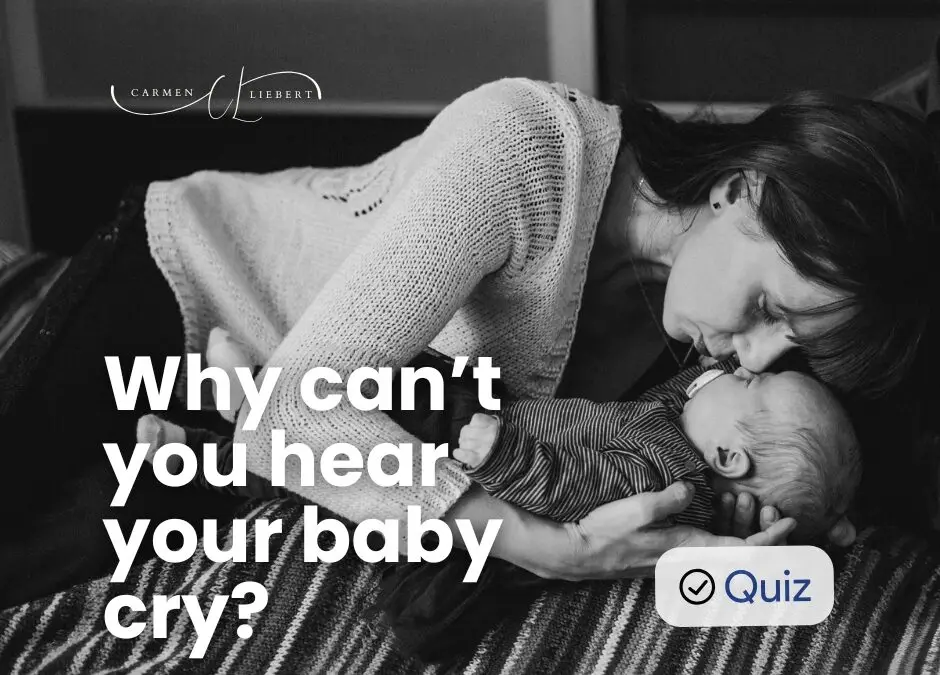
The one thing that makes baby sleep coaching successful |
Two years ago, an educated, organized & motivated client (lawyer 😉 told me something that made me thinking:
“Carmen, I understand the sleep plan and your holistic approach. I trust the science, myself and my baby. But I can’t hear him cry. I physically cannot handle it more than 2 minutes.“
That’s when I realised why baby sleep coaching sometimes (< 10% in my case) doesn’t totally work. It fails not because parents don’t understand my approach, but because of something much deeper: how our own childhood shaped our nervous system’s response to our baby’s crying.
Here’s what I started noticing: the parents who “couldn’t stick to the plan” weren’t lacking discipline. They were experiencing a strong reaction to their baby’s distress, one that was rooted in their own childhood experiences.
I began asking different questions:
- What happened when YOU cried as a child?
- Were you comforted, or left alone?
- Was crying met with warmth, or frustration?
- Did your emotions feel safe, or scary?
Here is what I discovered
Parents whose crying was answered → Often feel comfortable giving their baby space to develop sleep skills. They trust their baby will be okay because THEY were okay.
Parents whose crying was ignored or dismissed → Overcompensate by responding instantly to every sound, afraid their baby will feel the abandonment they felt.
Parents whose crying triggered anger or punishment → Experience intense guilt and anxiety when their baby cries, despite self-settling abilities.
Parents who experienced an unpredictable response → Feel paralyzed by conflicting instincts, wanting to help but not knowing how, changing their approach too quickly.
Here’s the pattern most people miss: Baby Sleep Coaching is not about “letting your baby cry.” It’s about the parents’ ability to tolerate temporary discomfort while their baby learns a new skill.
Think about it: when kids learn anything new like walking, talking, eating with a spoon—there’s frustration. There’s effort. There’s some fussing. But they don’t give up!
However, if YOUR childhood taught you that:
- Discomfort = danger
- Crying = abandonment
- Struggle = failure
- Emotions = bad
…then of course you’ll find it nearly impossible to give your baby the space and time they need to develop independent sleep skills.
This isn’t about being “tough” or “soft”, attached or cold parent.
It’s about understanding that:
- Your tolerance for your baby’s discomfort is directly linked to how your own discomfort was handled
- Your ability to stay calm during your baby’s crying reflects whether you felt safe when you cried
- Your confidence in “waiting at least 3 minutes” depends on whether you were instilled patience and trust in your childhood
What changed in my practice
When I help parents understand it’s more about their own worries and discomfort than about their baby’s pain or hunger, everything shifts.
They stop blaming themselves for “not being enough.” They recognize their reactions are over-protective, not weak. They can work WITH their nervous system, not against it.
And suddenly, they CAN stick to the sleep plan, follow the routine and apply the recommended soothing technique —because they understand why it felt so hard before.
I also realised that the question I put to my clients was misleading. Instead of asking if they considered themselves attachment parents (most of us do) I should dig a bit deeper and ask about their Attachment Parenting Style, which we can find out by taking a 2-minute QUIZ.
4 Styles of Attachment Parenting
✨ Confident – Your needs were met regularly, so you trust your baby’s process
💭 Worried – Your care was unpredictable, so you overcompensate with hyper-responsiveness
🛡️ Independent – Your emotions were dismissed, so you struggle with your baby’s big feelings
🌊 Overwhelmed – Your childhood was chaotic, so everything feels confusing
Here’s what this means for baby sleep:
Confident parents can give space because they experienced secure attachment themselves.
Worried parents need to build trust that short periods of crying won’t harm their baby, if a parent is close by or responsive, something they never learned.
Independent parents need permission to stay present with emotions—theirs AND their baby’s.
Overwhelmed parents need structure and support to regulate THEIR nervous system first.
Understanding your AP Style doesn’t make sleep coaching automatically successful.
But it gives you:
✅ Compassion for yourself when it feels hard
✅ Insight into what YOU need to succeed (not just your baby)
✅ Ability to recognize when old fears are driving current decisions
✅ Pathway to build the resilience you want to model for your child
The TRUTH?
Your baby’s ability to develop independent sleep skills isn’t just about them. It’s about YOUR capacity to hold space for their learning process and frustration. A similar reaction a teenager has to their own parents when they constantly contradict them – to learn new skills towards finding their own identity.
And that capacity was built (or limited) by how YOUR emotions were handled decades ago.
I created a 2-minute QUIZ to help parents identify their attachment style—not to judge, but to understand themselves better.
Because when you understand WHY hearing your baby cry feels unbearable, you can:
→ Develop strategies that work for YOUR nervous system
→ Build resilience gradually, not force it
→ Give your baby the gift of learning while feeling supported yourself
This is my holistic approach with sleep coaching: not just teaching babies to sleep. But helping parents understand themselves and much more about sleep.
Let me know if this resonates with you & book a Free Discovery Call to chat about it.




Carmen Liebert
Founder of Happy Baby Schlaf
Carmen Liebert is a certified Baby & Toddler Sleep Consultant, creator of the Baby Sleep Solutions Method. Over the last 5 years she has been helping 300+ English-speaking families across Europe get their sleep back through a holistic, science-based coaching approach which looks beyond routines and soothing techniques to uncover the missing pieces in each child’s sleep puzzle.
She specialises in babies & toddlers’ sleep from newborns to 4-year-old kids and also supports parents of autistic children with sleep challenges.