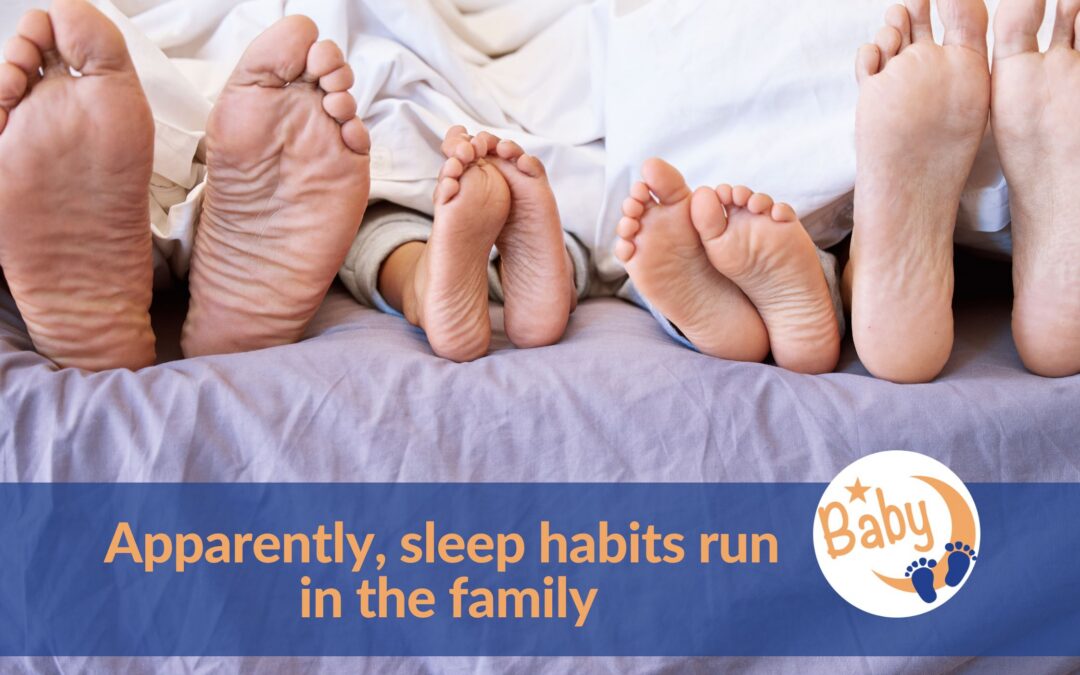
A new study of more than 100,000 parent-child pairs suggests that our children’s sleep and our own may be more connected than we thought.
I came across a new sleep study recently and immediately thought: parents from my circle need to hear about this.
Because we talk so much about the baby’s sleep.
When does your baby go to bed?
How many times do they wake?
How long are their naps?
Can they fall asleep independently?
But what happens if we zoom out a little and look at the whole family’s sleep?
A new systematic review and meta-analysis published in Sleep Medicine Reviews in July 2026 brought together 46 studies involving more than 100,000 parent-child pairs across 16 countries.
And researchers found something fascinating: parents’ and children’s sleep patterns seem to be significantly connected.
So… does your baby sleep like you?
Well, it’s not quite that simple. 😉
Researchers found associations in how long parents and children slept, how efficiently they slept, and even what time they went to bed and woke up.
The strongest connection was actually found in wake-up times, followed by bedtime.
Before every mother reading this thinks, “Excellent. Another thing to add to my list of responsibilities…” — that’s not what the study is saying.
It doesn’t prove that a parent’s poor sleep causes their child’s sleep problems. Most of the research was observational, so we don’t know exactly who influences whom and plenty of other factors may influence both.
And when you think about real family life, that makes perfect sense.
Babies don’t sleep in laboratories. They sleep in families.
A baby sleeps in a home where someone opens the curtains in the morning.
Where an older sibling needs to get to school.
Where Mum or Dad leaves early for work.
Where dinner happens at a certain time.
Where weekends feel different from Tuesdays.
And where someone occasionally decides that drilling into a wall at 7:30am is perfectly reasonable behaviour. 😉
Our sleep happens inside all of that.
Genetics and biology may contribute to the connection researchers observed, but so may shared routines, light, noise, meals, activity and the general rhythm of family life.
And that fits something I’ve observed again and again in my work: sleep is very complex and everything your child does during the day impacts their night and vice-versa.
Who really sets the rhythm in your house?
Think about tomorrow morning.
Who wakes first?
Perhaps your toddler starts shouting “MAMAAA!” at 5:47 and therefore holds the unofficial position of Family Alarm Clock.
Perhaps Dad gets up at 6am for work, the shower starts, lights go on and soon another pair of eyes opens down the hallway.
Or maybe everyone sleeps later at weekends.
Except the baby, obviously. The baby has not received the weekend memo.
Now think about evenings.
Who actually decides bedtime?
The clock?
Your child’s tiredness?
The end of dinner?
An older sibling’s activities?
The moment the other parent finally comes home?
There is no right or wrong answer.
What’s interesting is simply noticing the pattern.
Because children follow our rhythms. Light, meals, movement, connection, daycare, work and bedtime rituals send little signals to their body all day long.
We don’t consciously notice them, but our bodies do.
Try a little experiment
For the next three days, don’t try to fix anything.
Just become curious.
Notice:
- Who starts the day in your house?
- When does the house become bright and active?
- When do meals happen?
- How different are weekends from weekdays?
- What happens in the hour before bedtime?
- Does your child’s sleep seem different on days when the family’s rhythm is off?
And perhaps the most interesting question:
Does your child’s sleep changes on days when your emotional state is different?
No sleep log required.😉Just observe.
You may suddenly notice a pattern that’s been sitting under your nose for months.
What this study really tells us
We spend a lot of time asking:
“How can I get my child to sleep better?”
This new research is a nice reminder to occasionally ask a bigger question:
“How does sleep work in our family?”
Your child’s sleep doesn’t exist in isolation. Neither does yours.
You share mornings, evenings, light, noise, meals, routines, stress, laughter, busy Tuesdays and lazy Sundays. Of course some of your rhythms will overlap.
So my takeaway isn’t that parents should now start worrying about their own sleep for the sake of their children. We really don’t need to turn sleep into another parenting performance metric.
But it might help to be curious before we start changing things.
Zoom out. Watch your family for a few days. Look for rhythms rather than isolated “sleep problems.”
Because sometimes the most useful clue to your child’s sleep isn’t hiding in another wake-window chart.
It may simply be happening around them, in their environment.
And if you discover something interesting during your three-day family experiment, I’d love to hear about it.
Carmen Liebert
Founder of Happy Baby Schlaf
Carmen Liebert is a certified Baby & Toddler Sleep Consultant, creator of the Baby Sleep Solutions Method. Over the last 5 years she has been helping 300+ English-speaking families across Europe get their sleep back through a holistic, science-based coaching approach which looks beyond routines and soothing techniques to uncover the missing pieces in each child’s sleep puzzle.
She specialises in babies & toddlers’ sleep from newborns to 4-year-old kids and also supports parents of autistic children with sleep challenges.