
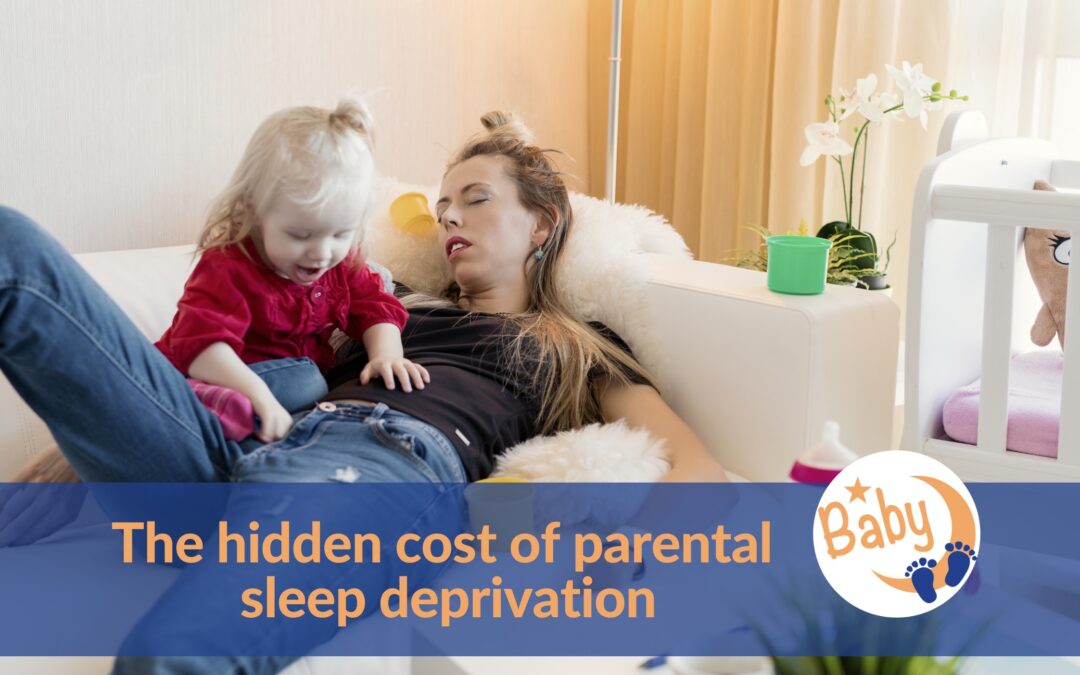
It’s 2am, and you’re standing in the kitchen with a bottle of milk in your hand, your brain wrapped in a kind of fog that makes everything confusing. You tell yourself it’s temporary, that you’ll catch up on sleep eventually, and most parents say exactly the same thing to themselves. But most also underestimate just how much that “eventually” lasts and ends up costing them.
Sleep deprivation is not just feeling tired. It builds up quietly over weeks and months, and it touches almost every part of your life, from how you feel inside your own head, to how you connect with your partner, to how you perform at work, and even to the decisions you make about your child’s sleep.
So, let’s look honestly at what’s really going on underneath the parental exhaustion.
It affects your mental health
A few rough nights here and there is uncomfortable, but manageable. But something is different when sleep stays broken for months at a time, because that kind of prolonged exhaustion actually changes the way your brain works.
When you’re sleep deprived, the part of your brain responsible for sensing danger becomes more sensitive and reactive, while the part that helps you stay calm and think things through clearly grows weaker and less reliable. That’s why small things can suddenly feel huge, why worries spiral faster than usual, and why your patience is so short before bedtime and why you cannot fully unwind to have a restful sleep (even when you little one does 😉
Research (Springer Nature study) shows that sleep deprivation and low sleep quality play a role in the development of postpartum depression and other mental disorders and the worse a new mom’s sleep is, the greater her risk of developing PPD. Moreover, babies of depressed mothers tend to sleep worse and are at high risk of experiencing toxic stress (impacting their brain development, if long-term).
None of this means you’re failing as a parent. It simply reflects how the body and brain naturally respond when they aren’t getting enough rest.
It puts pressure on your relationship
Tiredness rarely stays contained to just one person, it tends to spill over into the relationship between partners as well, often in ways you never imagined. When you’re running on too little sleep, you become more short-tempered and small disagreements can turn into bigger arguments much faster than they would if you were rested.
Research on new parents has shown again and again that sleep quality is one of the strongest predictors of how happy or unhappy couples feel during that first year after a baby arrives, regardless of baby’s temperament or how chores are divided between partners (study covered by ScienceDaily).
Many couples don’t recognize this connection while they’re going through it, and instead they start to wonder if something is fundamentally wrong with the relationship itself, when in reality, the tension they’re feeling often has far more to do with sleep than with each other.
It makes decisions harder
One of the most overlooked effects of sleep deprivation is the way it quietly reshapes your judgment, often without you even noticing it’s happening. A tired brain naturally reaches for shortcuts, becoming more impulsive and far less able to assess the long-term consequences over the relief in the moment. For parents, this often shows up directly around sleep itself, in choices like bringing the baby into bed at 3am “just this once,” giving up on a soothing technique after a single hard night, or switching strategies again and again before any one of them has had a real chance to work.
It becomes a frustrating loop, because the very exhaustion that makes these moments so hard is also what makes it harder to choose the right path that would actually lead to more rest.
Sleep deprivation follows you at work
The cost of sleep deprivation doesn’t stay at home either and it tends to follow parents straight into their workday, even when not many say it out loud.
Research has shown that operating on too little sleep can slow down reaction time and clear thinking to a degree that’s genuinely comparable to mild alcohol impairment (peer-reviewed study, BMC Public Health), which for a working parent can translate into slower problem-solving, more small mistakes, and real difficulty staying focused during meetings or while driving! Because sleep is also when the brain stores and organizes new information, ongoing sleep loss can make it noticeably harder to learn and remember things, to focus even on simple things.
All of this adds up to a real economic cost too, since poor sleep is estimated to cost businesses billions of dollars each year in lost productivity (RAND Corporation), and parents of young children make up a significant share of that toll. Yet because exhaustion feels so normal during early years of parenthood, it’s rarely identified as the real reason behind a slipping work performance or a missed deadline.
Why “just tough it up” doesn’t work
There’s a common belief that exhaustion is simply part of early parenthood, something to survive rather than something worth addressing directly, but the research (Sleep Foundation) tells a different story. Chronic sleep deprivation has real and lasting effects on your mood, your relationship, the way you think and work, which means struggling with it isn’t a personal failure, while taking it seriously enough to make a change isn’t selfish either.
The good news is that babies and toddlers can learn to sleep better, often faster than parents expect. With a holistic, science-based and responsive approach (following an age-appropriate routine and sleep windows, benefiting from natural light exposure, connection time with parents and balanced nutrition to support sleep, enough sensory input & movement to foster their development, with a calming wind-down ritual and a consistent way of responding at night), babies really can learn to settle and resettle back to sleep with less parental assistance and without any brain damage or attachment issues.
And when they do, everyone else in the house gets their rest back too. Sleep begets sleep, and when your baby’s sleep starts to improve, you’ll likely find that you start to feel more like yourself again as well.
Because when baby sleeps, family heals❣️
If you’re deep in the exhaustion right now and not sure where to even start, please know that you don’t have to figure this out alone. An experienced, empathetic sleep consultant can often make more of a difference than another blog article telling you to “rest when the baby rests.”





Carmen Liebert
Founder of Happy Baby Schlaf
Carmen Liebert is a certified Baby & Toddler Sleep Consultant, creator of the Baby Sleep Solutions Method. Over the last 5 years she has been helping 300+ English-speaking families across Europe get their sleep back through a holistic, science-based coaching approach which looks beyond routines and soothing techniques to uncover the missing pieces in each child’s sleep puzzle.
She specialises in babies & toddlers’ sleep from newborns to 4-year-old kids and also supports parents of autistic children with sleep challenges.