
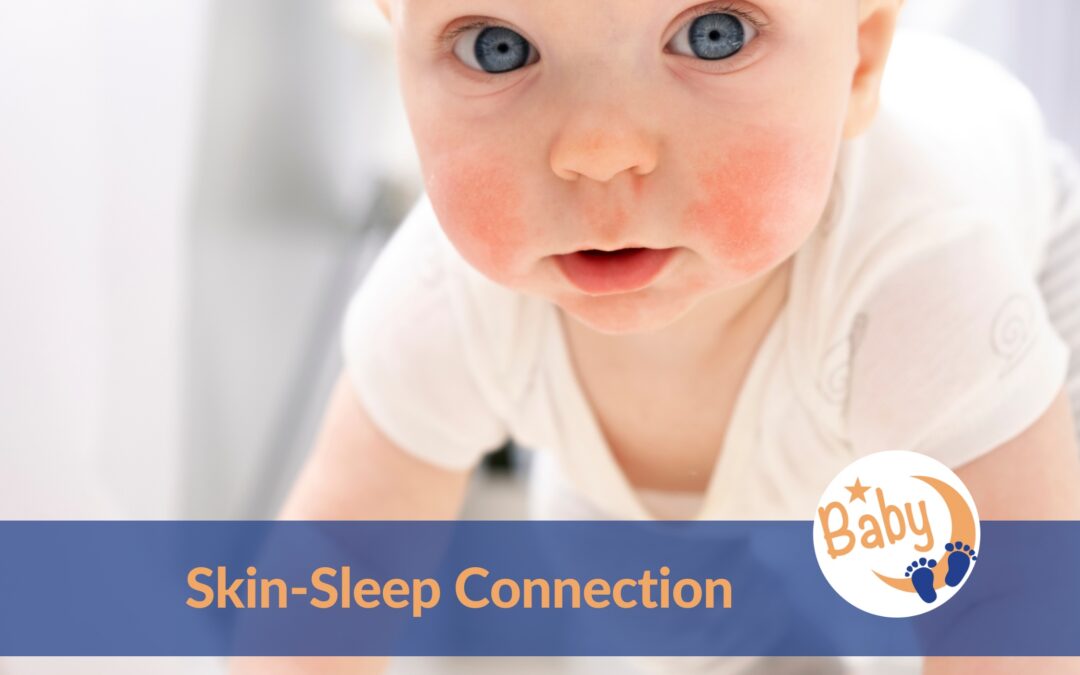
The sleep–skin connection
Many parents look first at routines & rituals when their baby wakes often at night.
They adjust bedtime.
They change nap timing.
They space-out feeds.
They introduce white noise.
They basically try everything to support their baby’s sleep and still, their baby wakes up at night again and again.
One important piece is easy to overlook: skin comfort.
For babies with very sensitive or atopic skin (also known as atopic dermatitis), sleep and skin are closely connected. When the skin feels irritated, sleep becomes lighter. And when sleep becomes lighter, the skin often becomes more reactive again.
Understanding this connection helps many parents suddenly make sense of frequent night waking.
What causes atopic skin in babies
Atopic skin (also called atopic dermatitis) usually does not have one single cause. It develops because a baby’s skin barrier and immune system are still maturing and react more strongly to everyday triggers.
One important reason is the skin barrier itself. In babies with this kind of sensitivity, the skin loses moisture more easily and becomes irritated faster by warmth, saliva, fabrics, or dry air.
Genetics also play a role. Atopic skin is more common if there is a family history of eczema, asthma, hay fever, or allergies. This simply means the skin tends to be more sensitive and needs more time to adjust.
Environmental factors can make symptoms more noticeable. Dry indoor air in winter, overheating during sleep, fragranced skincare products, and saliva during teething are common skin triggers in the first year of life.
Some babies also show stronger skin reactions when new foods are introduced. This does not automatically mean allergy, but it can temporarily make the skin more reactive and sleep lighter for a few days or weeks.
The encouraging part is that many babies’ skin becomes more stable as their skin barrier matures, usually after 12 months of age. Until then, however, sebum production remains low, which is why baby skin is drier compared with older children.
Why skin discomfort increases at night
Many parents notice that their baby settles quite well in the evening but starts waking more often during the second part of the night.
This is not random.
During sleep, the body naturally becomes warmer. At the same time, the skin loses moisture more easily overnight, through sweating. In babies with sensitive skin, this can increase itching exactly when they are moving between sleep cycles.
Babies cannot explain this feeling yet. Instead, they show it through fussiness.
They may rub their face.
They may turn their head from side to side.
They may wake and need help settling again.
From the outside, this often looks like a sleep habit problem. But the body is simply reacting to a physical discomfort.
Why babies with sensitive skin wake more between sleep cycles
Babies move through lighter sleep roughly every 90-120 minutes during the night.
If their body feels comfortable and they already know how to connect sleep cycles, they usually continue sleeping.
If their skin feels irritated or they fully rely on the parent to slide into the next sleep cycle, they wake up fully and ask for support to fall back asleep again, by crying.
Very often, baby’s nervous system is responding to physical signals coming from the skin.
Parents sometimes describe this as: “My baby suddenly started waking much more often than before.” Or “We thought it was a phase, but it has continued for the last 3 months, and we are simply exhausted.”
Why bedtime can suddenly become harder
Another moment when skin discomfort often becomes visible is bedtime itself.
Many babies with sensitive skin become more unsettled once they are warm inside their sleeping bag. Warmth can increase itching, especially on dry cheeks, behind the knees, around the neck, or on the wrists.
Some babies then need longer to fall asleep. Others settle well but wake again shortly afterwards.
When skin comfort improves, bedtime sometimes becomes easier. Sure, for longer and more connected night sleep, baby still needs to learn the skill of settling and resettling to sleep more autonomously.
Teething and saliva around the mouth can also affect sleep
Even if teething does not usually impact baby sleep as much as we think, for children with atopic skin, this can become a bigger issue.
Here is what’s going on.
Most babies produce much more saliva during teething. Saliva contains digestive enzymes that are helpful later for breaking down food, but on sensitive baby skin they can weaken the skin barrier. When the cheeks, chin, or neck folds stay moist for longer periods, the skin can become red, rough, and itchy.
This irritation often becomes more noticeable at night, when babies get warmer and the skin naturally loses more moisture overnight. Some babies then rub their face into the mattress, turn their head from side to side, or wake shortly after falling asleep.
In these moments, what looks like “teething sleep problems” is sometimes actually skin discomfort around the mouth and cheeks. Supporting the skin with gentle protection and cold toys to chew on, before bedtime can make settling easier again and help babies move more smoothly between sleep cycles.
The sleep–skin loop parents can fall into
I guess it is clear by now, how much sleep and skin can influence each other.
Furthermore, when babies sleep poorly over several nights, their immune system works less efficiently. This can increase inflammation in the skin.
More inflammation often means more itching.
More itching leads to more restlessness and more night waking.
So a vicious cycle begins: poor sleep → lower immune regulation → more skin inflammation → more itching → more night waking
The role of cortisol
There is also another important piece in this loop: cortisol, the body’s stress hormone.
Cortisol normally goes down in the evening so the body can enter deeper, more restorative sleep. During the night, this lower cortisol level supports immune activity, body’s cleansing & repair system.
But when the skin feels itchy or irritated, baby’s body may release more cortisol to help control inflammation (cortisol has a natural anti-inflammatory role too).
At the same time, higher cortisol levels make sleep lighter.
So the body is trying to protect the skin and rest at the same time — and these two goals can sometimes work against each other during the night.
More itching can lead to more cortisol.
More cortisol can lead to lighter sleep.
Lighter sleep can lead to more night waking.
This is another reason why babies with sensitive or atopic skin sometimes wake more often even when age-appropriate routines are already working well.
How can parents support their baby’s skin to improve sleep
Before looking at paediatric sleep, we should first try to support our baby’s skin to make them feel calm and safe. This is actually not so complicated.
Many families notice an improvement on their baby’s skin when:
- they apply a gentle fragrance-free moisturiser before bedtime
- after a short lukewarm bath
- dressing the baby in breathable cotton sleepwear.
- organising a cooler sleep environment.
- avoiding overheating the sleeping room.
- using a humidifier during the night.
Because when babies feel more comfortable and safe “in their own skin”, they often transition more smoothly between sleep cycles and need less help resettling during the night.
The sleep-skin connection matters for the whole family
Sleep is not only about routines & rituals.
It is also about comfort & safety inside the body.
When babies feel physically calm, they settle more easily and stay asleep longer. Nights become more predictable. Evenings become quieter. Parents feel more confident again.
Sometimes the missing piece of the sleep puzzle is simply understanding what the baby skin is trying to tell us.
If your baby wakes frequently at night despite an age-appropriate routine with early bedtime & nice bedtime ritual, full feeds & balanced meals, natural light and outdoor exercise, skin comfort may be one piece worth looking at more closely.
Supporting the whole sleep puzzle often brings the positive change families are hoping for.
In case you are still struggling with your baby sleep and you want to support your little one have longer stretches of night sleep, book a free Discovery Call to sort things out.




Carmen Liebert
Founder of Happy Baby Schlaf
Carmen Liebert is a certified Baby & Toddler Sleep Consultant, creator of the Baby Sleep Solutions Method. Over the last 5 years she has been helping 300+ English-speaking families across Europe get their sleep back through a holistic, science-based coaching approach which looks beyond routines and soothing techniques to uncover the missing pieces in each child’s sleep puzzle.
She specialises in babies & toddlers’ sleep from newborns to 4-year-old kids and also supports parents of autistic children with sleep challenges.